myMEGusta

Named for things that please me (“me gusta” in Spanish) and rhymes with balabusta (Yiddish for “good homemaker”).

Hail to Ye Olde Non-Locavores!

Let’s face it.

If our culinary forebears had stuck to locally grown foods, and not carted crates of edibles half way around the world, we would be boring eaters, indeed. Many fabulous dishes and flavors we associate with the Old World would not exist.

Of course, there were mistakes along the way as people moved foods into new environments. The most egregious that comes to mind is phylloxera. A root louse to which American grapes are immune, these pests hitchhiked to Europe on vine cuttings and nearly destroyed the European wine industry in the 19th century.

And, the Americas could have done without Europe’s dandelions, thank you.

On a happier note, take chili peppers and bell peppers, originally from Latin America.

The source of the heat we associate with Indian food, chili peppers did not exist there until introduced by Portuguese and Spanish sailors only a few hundred years ago. Vindaloo, the searing stew from the Goa region, is actually a derivative of a Portuguese dish called “carne de vinha d’alhos”, meat with wine and garlic. Peppercorns, native to the Far East, used to be the main source of culinary heat in that part of the world, and having tasted fresh green peppercorns on a curry in Bangkok, I can attest to their fiery flavor.

What would Hungarian cuisine be without paprika? Similarly, stuffed bell peppers are staples of many other middle/northern European cuisines, and Italian sausage and peppers is a classic.

Tomatoes, eggplants and potatoes are other foods of the Americas which enriched cuisines wherever they were imported. Imagine pasta without red sauce, Provence without ratatouille, and Ireland without potatoes.

While legumes such as fava beans, lentils, dals, soybeans, and black eyed peas were staples in the Old World, it was not until the 16th century that string beans, navy beans, lima beans and the like were introduced there. Enterprising French botanists created what we now call the flageolet, a delicious bean we associate with that country; similarly cannellini beans were developed in Italy from American stocks. France’s famed cassoulet, originally made with favas, not the white beans used today, is the ancestor of Boston baked beans.

Traveling in the other direction across the Atlantic were most of the fruits we Americans take for granted: peaches, plums, pears, melons and even apples.

“As American as Apple Pie”? Not quite!

Majestic Mole to the Rescue

No, not a competitor for Mighty Mouse.

Rather, guess what’s got chocolate and nuts and makes people of all ages happy, even when facing down turkey leftovers (“Not turkey AGAIN!”)?

I’m thinking about mole (MOH-lay), that thick brown sauce which is the perfect companion for poultry.

It came to mind, and to my table, recently in Mexico, where Thursday’s meals comprised things like shrimp tacos, huitlacoche empanadas and suckling pig cooked “sous vide” in Yucatan seasonings. No ersatz “Thanksgiving” menus offered in tourist restaurants for me. But those signs did remind me of the mountains of Thanksgiving leftovers now lying about in American kitchens.

The mole we’re talking about is not the slightly sweet, somewhat cloying glop that can turn up in some restaurants, merchandised as ‘chocolate chicken’. Rather, it’s the rich, thick, brown sauce which can transform any turkey to a delicious dish, even if the meat is a little dry. (Let’s be honest, folks.)

The first thing to remember about mole is to forget about the chocolate flavor.  Moles do indeed have a small dollop of dark chocolate tossed in at the end, but this is to enrich the sauce and add complexity to the flavor. It is not intended to dominate, and should be barely discernable, if at all.

While moles have been part of the wonderful and varied cuisines of Mexico for centuries, some of the key ingredients in most modern recipes – sesame seeds and ground almonds – were brought by the conquistadors from the Old World.

One of the best moles I have ever had was, incredibly, on an airplane from Mexico City to Chicago.  Sitting in the front of the plane, I was one of the few passengers to opt for the Mexican entrée. The thick ochre sauce (on rubber chicken, alas) had clearly been made with love, maybe with a recipe from the chef’s abuela (grandmother), and tasted of ground almonds with just a hint of chili, clearly having been made in a small batch.

Moles vary by region in Mexico, and by family recipes and traditions. They are, most simply, a ground nut/sesame seed/chili based sauce, and can be further thickened with tortillas or masa harina (the ground corn from which tortillas are made). And that dot of chocolate.

The most efficient way to create a mole is to make the sauce separately from the meat, poaching that separately, or just using leftovers. Turkey (or chicken) legs and thighs are particularly delicious in a mole sauce because of their natural moisture, but breast meat works.

Mole makes a fabulous sauce for enchiladas, too.

Now, if I get to the store really fast, there may still be some loss leader turkey to replenish the freezer.

Everyone Deserves Their Crabby Moment

How can you not like crabs?

They walk sideways, have funny, googly eyes sticking up, and you can play with mallets making a big mess while eating them.

They come in different shapes and sizes all over the world. Their names can be pretty like Snow or off-putting like Mud, they can be brown or blue or speckled, giant or the size of your thumb. Some are prized for their roe, as for making Maryland She-Crab Soup, and others for their succulent, ample meat served dripping in butter, and some in regional specialties like Singapore Chilli Crab (best enjoyed al fresco on Clarke Quay overlooking the Singapore River) or Crab Stuffed Chilis in Playa del Carmen, Mexico.

There are so many varieties that one could do an Around the World in Eighty Crabs trip.

One autumnal craving in China is the craze for Hairy Crabs, sitting in markets, bound with bamboo to look like little papooses. Their claim to fame is a particularly rich roe. At their meatiest in the fall months, they’re enjoyed by everyone who can afford them.

In a Saigon Market

Distant relatives of these little monsters are the speckled crabs you find in the market in Viet Nam.

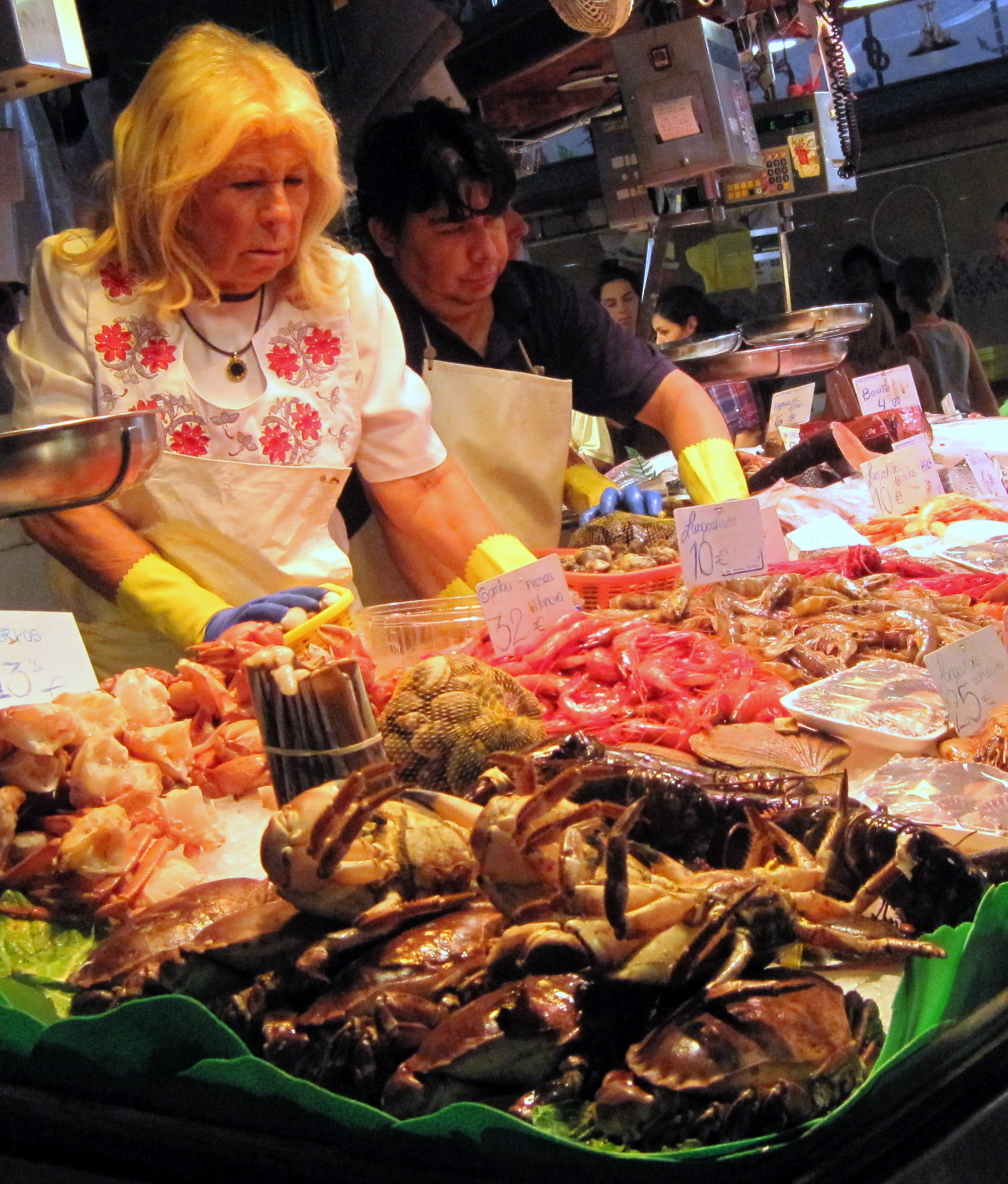
Europeans use every kind of crab they can pull out of the water, from the large box crabs (not unlike Pacific Dungeness crabs and the ones fished off New England) to tiny ones which find their way into piles of teeny sea creatures sold in French markets (particularly in Provence) labeled Soupe de Poisson.

A Crabby Day in Barcelona

People who dwell by the sea can often be seen dangling a bitten up chicken leg off of a string, then happily pulling up a hungry crab.

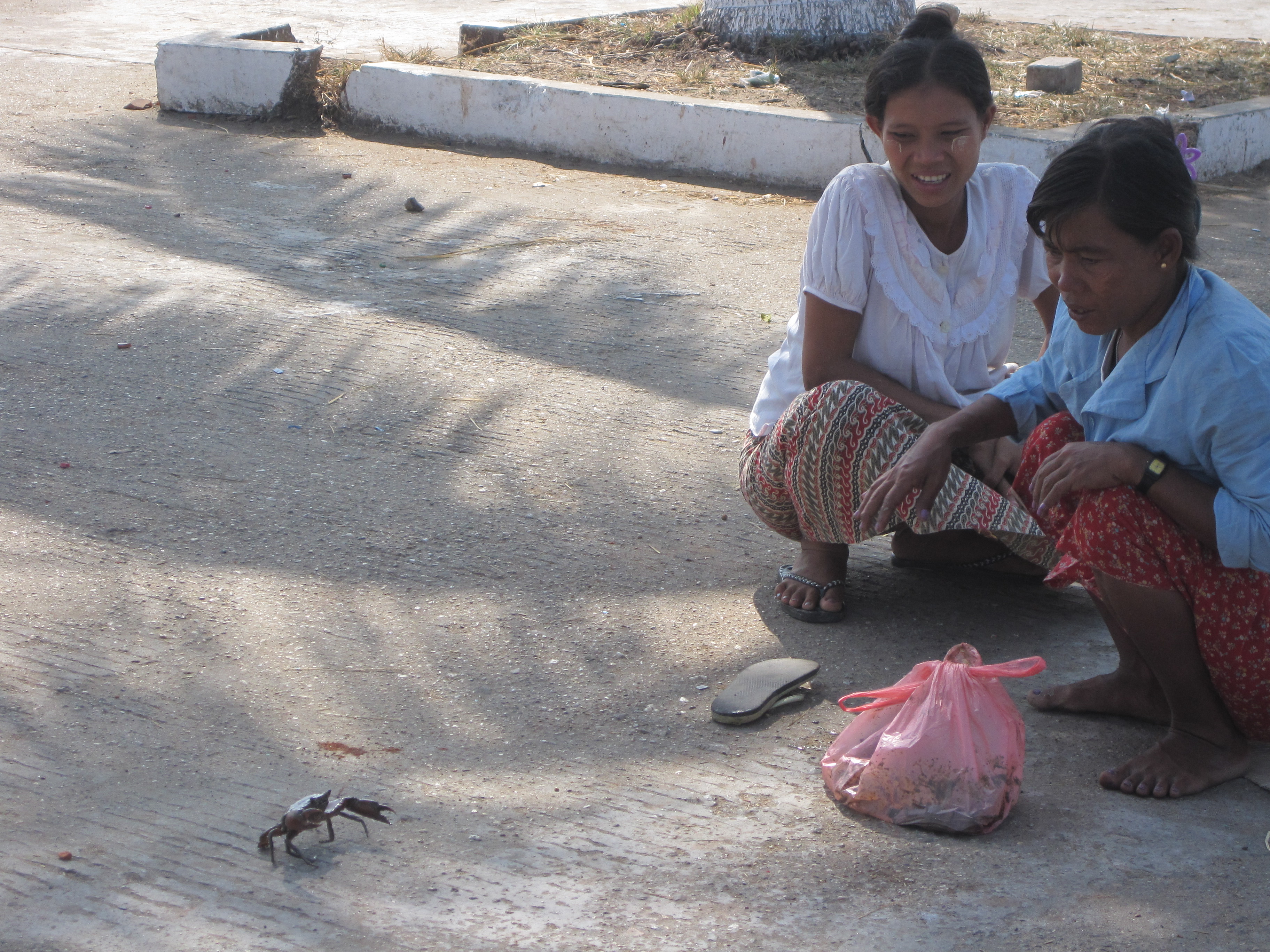
Some Yangon, Myanmar, denizens make a meager living by capturing crabs to sell on the streets, letting them run wild to advertise their freshness. My guide there took pity on the crustaceans, purchasing all of them from the delighted vendor, then proceeding to the dock to set them free.

A Lucky One in Myanmar

Soft shelled crabs are a summertime treat, whether lightly sautéed or in an Asian dish (substituted shrimp, for example). Freshly molted, most are now commercially fished while hard, then held until molting time and transferred to a protected area where they’ll survive until they find their way to a market and a kitchen.

One thing offsetting the onset of winter is that stone crab season has begun. You no longer have to be in Florida to savor them. That is, of course, if you have really good seafood stores or restaurants selling the claws, the only part used, fresh, not frozen. The idiosyncrasy of this type of warm water crab is that one of its claws is designed to fall off in battle, and it regenerates. So the crabbers only take the one, skillfully knowing how to do so without fatally injuring the animal, and leave the beasts to live another day (and grow another claw in about a year’s time).

Now, you go have yourself a crabby, crabby day.

myMEGusta Samples: Bar Rosso

Bar Rosso, the cavernous vino bar on Spring Street in Stamford, CT, opened to great fanfare in early 2011. Created by the parent company of the wildly popular Napa and Company, Bar Rosso promised a casual but delicious ambiance with great food, and, for the most part, it continues to deliver.

Small bar snacks and light dishes are the calling card for this gathering place for the attractive after-work crowd as well as local denizens having a night out with the girls (or the guys, for that matter, transfixed by sports TV over the bar). The layout begs for easy, simple dining, with the majority of downstairs seating being at or near the bar, including an expanse of space overlooking the wood burning pizza oven (more on that later).

Sharing is easy and encouraged, a perfect way to taste little dishes like crispy honey calamari (accented with chopped olives and parsley) and zesty meatballs and gravy. Spicy shrimp and bean disappointed, not in its sparkly flavor, but in undercooked cannellini beans. An excellent selection of greens (“field lettuces”) and shaved raw vegetables such as carrots, beets and fennel were a perfect foil for not-too-sweet honey-thyme vinaigrette.

The Bar Rosso burger, brilliantly served with a generous portion of lightly dressed mixed green salad (as opposed to something fried, no guilt there!) was delivered exactly as ordered: pink but juicy prime sirloin on a focaccia roll garnished with mushrooms, prosciutto, crispy shallots, provolone and balsamic aioli.  This spurred our group to order some polenta fries: airy, almost cake like, bars of polenta, lightly fried with a sprinkling of sea salt, and in an appropriate, modest portion.

The pizza was good, but “good” is not good enough in this part of the world where there are truly stellar examples to be found on almost every corner. What was billed as “tomato gravy”, slow cooked, complex Sicilian style red sauce (as served with the meatballs), was really a marinara, nice but not accurate. The fresh mozzarella, basil and pepperoni were right on target (how hard is that?) but the crust, while competently chewy and flavorful, was crisp, but not crisp enough.  One charming touch was the delivery of extra garlic, red pepper flakes, and grated cheese immediately before the pie arrived.

Desserts continue in the Italian bent, including excellent gelatos, an order of which brings three scoops of flavors like fresh mint, citrus crème fraiche, deep chocolate, salted caramel, or olive oil.

Service is exceptionally friendly without being intrusive, and well versed on the menu, wines and kitchen.

The exclusively Italian (with the exceptions of one high priced Champagne and the “house” Cabernet from Napa, its relative down the street) wine list ranges from the very affordable to the very expensive, a strategy also evident in the by-the-glass selection.  Wines are arranged by grape and style, easing the way for those who may not know their Italians, particularly the esoteric, while still providing an adventure for the more knowledgeable customer.

Bar Rosso, 30 Spring Street, Stamford, CT 06901 (203) 388-8640 www.barrossoct.com

A Smutty Story (G-Rated)

Imagine the scene on a hot summer’s day, walking in the shadow of high corn stalks.

You see it a few feet away.

Among all the beautifully formed ears of corn is the misshapen one with odd dark stuff bursting like a brain emerging where little kernels should be.

For certain farms in Mexico, this is a fairly common occurrence, because they have inoculated their corn crop with huitlacoche
(wheat-lah-coach’-ee), also known as corn smut, an expensive delicacy with wonderful flavor and texture. If harvested in time when the infected kernels have just started to bubble up, it has the texture and taste of mushroom-flavored corn.

But corn smut is the bane of American farmers.

This fungus attacks the ears and, if not removed, develops into pods of spores which burst and infect all of its neighbors in the field, effectively starting a chain reaction which can ruin an entire crop. This nuisance will even stay in the earth to hit next year’s planting.

Not surprisingly, no one wants this airborne pest cultivated in the farm next door, or even down the road. An infected ear is something farmers need to get rid of, and fast.

To obtain some huitlacoche, you can hop a plane to Mexico and may find it fresh in the market. The easier ways are to find a good Mexican restaurant, or in a can in a Latino grocery.

But the most fun is to stumble upon it accidentally in a farmer’s field. Once upon a time, there was a you-pick-it farm in New Jersey where customers could walk the cornfields.

What a delight it was to stumble upon huitlacoche. And the farmer was even more thrilled to see it being toted away, for free, of course.

And even more fun came later in the kitchen, as the kernels found their way to a sizzling saucepan to sauté, and then be folded inside quesadillas. They make a mighty delicious omelet filling, too.

What nice dividends for doing the farmer a favor and performing a public service for all of her neighbors!

“Oh Cod!” A Heady Adventure in Alaska

Wandering through the old Russian port of Sitka, Alaska, you can visit a beautiful old Orthodox cathedral, hear about a recent crime wave (it had to do with people leaving the keys in their cars then finding them abandoned on the dead end roads out of town), and stumble upon hoards of locals clustered around large bins in a dark ally.

And that last experience was the cause of the one time I’ve wished a trip was ending, not at its beginning.

Sitka, spanning two islands of the Alexander Archipelago, is one of the biggest black cod fishing ports on earth. It’s also a cruise embarkation point for small ships like the National Geographic Sea Bird.

So, on a sunny September day prior to boarding, this nosy wanderer was strolling along fishery row, giant structures designed to receive boatloads of sea creatures through one door and spit out processed fish, through another.

But at a side door, in the shadows, were people doing something undecipherable.

Moving closer, it was clear. They were harvesting.

These were workers, plucking out the succulent head meat from sparklingly fresh black cod carcasses, trimmings which would otherwise be wasted.  With the company’s blessing, they got to take “the best part,” glistening pieces of the tenderest meat on the fish.  Some Sitka denizens were a little fuzzy as to where Connecticut is located (“near New York”), and were stunned to learn that an Easterner was aware of this local treasure, believing that it is all shipped to Japan.

They’d have happily sent some tidbits home with me, had I been heading East instead of toward the glaciers.

In the Northeast, black cod can be found on occasion in the fish market or in seafood restaurants, but more commonly in two other venues: In Japanese restaurants prepared as black cod collar (aka head) broiled in miso, and as smoked sablefish in delis.

Its firm yet unctuous texture and flavor is similar to another, better known cold water treat, Chilean sea bass (formerly known as Patagonian bonefish) from the frigid south side of the world. Both have a high fat content, rendering them virtually impossible to overcook. But the latter is now endangered, whereas black cod from the North Pacific is considered one of the most responsible and sustainable fisheries. Another thing they have in common is that black cod is not related to any other cod, nor is Chilean sea bass connected to any other kind of bass.

Whatever it’s called, too bad a sample didn’t travel back to my Connecticut kitchen.

Halloween Special: Top Ten Creepy Edibles

MyMEGusta.com is all about fun experiences which happen to involve food.

But it’s Halloween, the one time of the year to dwell on scary things, and actually have fun doing it.

So, in celebration of the holiday, here are Mary Ellen’s Top Ten Creepy Edibles: Not tripe, chicken feet, duck tongue or pig intestines, but the Real Hard Core.

Add a comment with the foods that make YOUR skin crawl!

1 Macaroni and Frankenstein-cheese-product pizza – exponentially worse on a bad crust.

2 Chalazas. These are the disgusting white connective membranes in eggs which hold the yolk in place and can show up in things like pancakes if the eggs are not properly beaten.

3 The witch’s cauldron boiling oil they pour over dishes depicted in Red Lobster and Olive Garden ads.

4 Wild mushrooms other than the foolproof two, or four, or five, depending on who has done the picking. No kidding around on this one, even some “experts” have had their last meal this way.

5 Cloudy “mineral water” for sale on the street in third world countries.  And seeing tourists drinking it.

6 Similarly, ice cubes on the former Northwest Airlines after getting one with a baby carrot inside. Worse, their customer service
didn’t seem to understand what the problem was.

7 An Icelandic nightmare: A “cake” constructed from mayonnaise and wonder bread, room temperature, of course.

8 That yellow grease they offer for movie popcorn, sometimes labeled “golden showers”.

9 Most corporate recipes ghoulishly concocted to use several of their products. One scary “dessert” stands out in memory:  Instant pistachio pudding, Cool Whip, lime jello.

10 Fermented tea leaves in Myanmar, a snack, not the basis of a beverage. In addition to having seen this in the market (flies
a-swarming) it looks like, well, rotten tea leaves.

I cannot wait to see more from my readers!

The Stalker

You look for them anxiously when the time seems right. Sometimes you’re too early, nothing. Sometimes they are there, but disconnected and lost in a crowded box, just OK.

Then they appear, perhaps first outdoors in a market, or maybe lying naked among scads of lesser, cellophane wrapped denizens of the produce section.

This is the annual arrival of Brussels sprouts au naturel, a 3 foot long stalk with little orbs just waiting to be popped off and cooked
into one of fall’s best treats, even better if harvested after the first frost. It’s even fun to carry out of the market, too long to fit into a bag, appearing like the baguette carried by a French guy in a beret.

Should the idea of Brussels sprouts conjure up the taste memory of olive green mush with a funky taste and worse smell, remember that these were probably abused by having been overcooked to death.  Wipe clean the slate.

Fresh ones, in season, are sweet and delicious, and super easy to prepare.

As I pen this (actually with a pen, in the kitchen), sprouts are simmering in chicken stock, butter, salt and pepper, the essence of
simplicity, and just about done, the poke of a paring knife getting just a little resistance.

Other quick and easy (depending on what’s on hand) preparations are with pancetta and olive oil or with duck confit fat (a great
byproduct of another autumnal treat). They can be shredded and smothered like any other green vegetable, like spinach, or roasted.

If the chef has the wisdom and foresight to prepare too many Brussels sprouts for one sitting, the leftovers can be tossed into some stock, perhaps with leftover potatoes, to become soup du jour the next day. YUM

Also known as Choux de Bruxelles (cabbages of Brussels), sprouts are believed to have been cultivated in the Low Countries for hundreds of years, not becoming really widespread until the 20th century.

So, don’t travel to Brussels expecting to find sprouts everywhere.  That would be mussels, frites, and waffles, and that’s another whole story.

Ruined

Yes, travel will do that to you.

Most recently, it was the Iberico Ham in Spain.

We ate it every day.  We ate it in the pool. We ate it in restaurants.  The supermarket (never mind the heavenly La  Boqueria market in Barcelona, or Fairway, I’m talking about Stop and Shop type places), had Jamon Iberico corners. The airports have Iberico ham restaurants the way we have Jamba Juice stores.

For the uninitiated, the source of this treat is a black Iberian pig, either pure bred or a minimum 75% pure. The quality of the ham depends on the breed, the amount of corn and acorns and feed at the end, for lesser types, and the 12 to 48 months aging, again a quality factor.  Sliced super thin, it bursts with flavor, the best with just enough chew and just enough fat.

I’ve never met a slice of Jamon Iberico I didn’t like.

Then there was the trip to Tokyo with the daily (at least) toro. And the regular pilgrimages to Berthillon in Paris. Note to self: It may be time for another quality control check on the sorbets.

The trials we travelers face!

“But what do you do with all those raspberries?”

Years ago, living near wonderful U-Pick-It farms in New  Jersey, the owners would ask such questions, perhaps wondering what kind of  person walks off with gargantuan takings of perfect, dead ripe produce week  after week.

Nothing’s changed.

I’m the one hauling too much corn, tomatoes, peaches (you  name it), through the farmer’s market parking lot. The staring lady who cannot  decide between one nectarine and the other probably thinks I am cooking for a  family of six, or for the firehouse down the street.

But what do I do with all that eggplant?

A key strategy for the single cook with an embarrassment of  market riches is to think of every dish as prep (or “mis en place” as a French  chef would call it) for something else.  Today’s ratatouille may be the go-with for grilled lamb chops on a  summer evening, a cold salad tomorrow, and a quick post-golf lunch with pasta  and grated cheese the next day, and the rest in individual frozen portions, a  taste of August throughout the fall. And this is the key:  Buying at peak, enjoying the moment, and  consuming the rest on a future day when the ingredients won’t be nearly as  good, or nearly as fun to work with.

Post Navigation