myMEGusta

Named for things that please me (“me gusta” in Spanish) and rhymes with balabusta (Yiddish for “good homemaker”).

Get a Room…

Hotel dining. GOOD hotel dining.

Usually the skeptic, I found out how wonderful this can be in Hong Kong in the 80s.

A knowledgeable friend who knows the Far East advised that the best was to be found in the top hotel dining rooms.

The best chefs were doing their magic independent of the green eyeshades: the F & B’s (food and beverage cost control functionaries). Ingredients were impeccable, kitchens were the cleanest (an issue at the time), and fancy hotels were reaping a huge public relations benefit while the chefs benefited from the traffic and location.

More recently, when in Chengdu, China, I made the Shang Palace in the Shangri-La Hotel my favorite spot for dinners when on my own, enjoying superlative food, whether the Cantonese classics or local Szechuan specialties. On my third night, the manager asked if I had moved in.

The croissant I had last year at the Hong Kong Mandarin Oriental Cake Shop rivaled the best I’ve had in Paris.

In the past, it could be assumed that the great hotels would have excellent dining. Take, for example, the Waldorf Astoria’s restaurants when Arno Schmidt was executive chef. Some places, like the New York Mandarin Oriental, still deliver a wonderful restaurant experience.

But most hotel dining has a well-deserved reputation for expensive mediocrity. The tides are, in some cases, turning. Taking the elevator instead of a cab is no longer necessarily a compromise in the United States.

An excellent example, and inspiration for this blog, is Distrito, celebrity chef Jose Garce’s confection in the Saguaro Hotel in Scottsdale, AZ. His “new twists on Mexico City street food” are almost universally delicious, and better than most of the competition in Old Town. Ceviches and salads were the standouts.

So, don’t automatically write off the hotel dining room. Find out who the chef is and check the local reviews. But, if the menu is pedestrian, take a walk.

PS The comments about the impact of cost control on food quality (they’re just doing their job, like the executioner in A Tale of Two Cities) have nothing to do with the wonderful FnB restaurant in Scottsdale, AZ, chef Charleen Badman’s jewel in the desert.

Sous Vide: Don’t Try This At Home

Unless you want to spend a fortune on a special machine, that is.

Someone recently asked what sous vide (soo-VEED) is all about, other than being one of these techniques you find in cutting edge (vis: expensive) restaurants.

Moo Restaurant in Barcelona serves an amazing example. Featured simply as “fried codfish with peppers, legumes broth” the fish was satiny inside a shatteringly crisp breading and was set atop vegetables in a light broth. The menu didn’t mention it, but my server confirmed that the fish had been cooked sous vide then finished by deep frying to achieve the magical texture.

The phrase “sous vide” is French for “under vacuum” and is a simple concept: The item is vacuum sealed in a plastic bag (not exactly green, but that’s another column), poached but never to the boiling point, and then finished, perhaps by frying and/or roasting. It comes out super tender, smooth textured inside but the outside looks normal.

A not-so-minor detail is that unless the process is exactly right, the dish may be laced with deadly botulism.

A small sous vide machine will set you back $500 or more, and larger commercial versions can run into the $1,000s. Marco Pierre White advocates making do-it-yourself sous vide chicken in his autobiography, The Devil in the Kitchen.  I’m not going to try it, and don’t recommend this for readers either.

Instead, there are numerous old-fashioned and completely safe methods for gently cooking foods and preserving the delicious juices, although they don’t have the same silken texture or benefit of browning at the end.

One is called, in French, “en vessie” (on-vess-EE), which means wrapped in a pig’s bladder (or in a plastic bag) and poached.  The most famous of this genre is made with Poulet de Bresse (chicken from Bresse, considered France’s finest). The bird is put into the bladder (or bag) and poached until thoroughly cooked, and the juices are poured over it (or into a sauce).

Another is baking “en Papillote” which means sealing in parchment paper, perhaps with wine, herbs and other seasonings, and baking, a very popular method for fish fillets. The parchment is opened at the table, releasing a steamy aromatic cloud, again with the juices all captured and served.

Beggar’s Chicken, the wonderful Chinese dish which is a chicken roasted in clay, is exactly the same principle. In the modern version, the bird is seasoned, perhaps stuffed, then covered in pottery clay, optionally also wrapped in lotus leaves, then baked.  The clay all comes off and you can discard the skin. The chicken, if left to rest after cooking, will have absorbed most of its juices back – delicious. Variations on this theme include baking in salt or wrapping in foil.

Beggar’s Chicken is said to have been invented when a starving man stole a chicken, then hid it in mud. Later cooking it in a fire without rinsing off the mud, he discovered that the outside had solidified and the meat was unusually succulent.  Accidental genius!

Whee! Whee! Whee! Happy Year of the Dragon!

When it comes to Chinese New Year, I am like the annoyingly happy Geico pig.

There’s really nothing not to like about this holiday: an excuse to eat wonderful food in fun surroundings, at its best, in a large group for a custom-made banquet and little tastes of lots and lots of things.

2011 was my lucky year, having been invited to celebrate the Year of the Rabbit in Chengdu, Szechuan Province, China.  Szechuan peppercorns! Pandas!

My first dinner on arriving was in a cavernous restaurant full of families obviously enjoying themselves immensely. I was the only non-Asian in the room, and our dinner included 3 cold dishes: smoked salt and pepper rabbit*, shredded chicken in red oil,  and watercress in Szechuan oil dressing; 4 hot dishes: leatherback turtle (an amazing gelatinous texture in a green herb sauce), frog in cellophane noodles, braised duck, and taro in a red broth; ending with seaweed and pork ribs soup and chive dumplings.

Whee! Whee! Whee!

*I’m still surprised that the Chinese zodiac honoree kept showing up on menus.

One family banquet included an incredible variety of 19 dishes with no two flavors or textures the same.  Standouts were the best roast pigeon I have ever had anywhere, hairy crab in a zesty brown sauce on glutinous rice cakes, and skinless walnuts poached in wine and chicken stock with broccoli (my notes read: “stunning”).

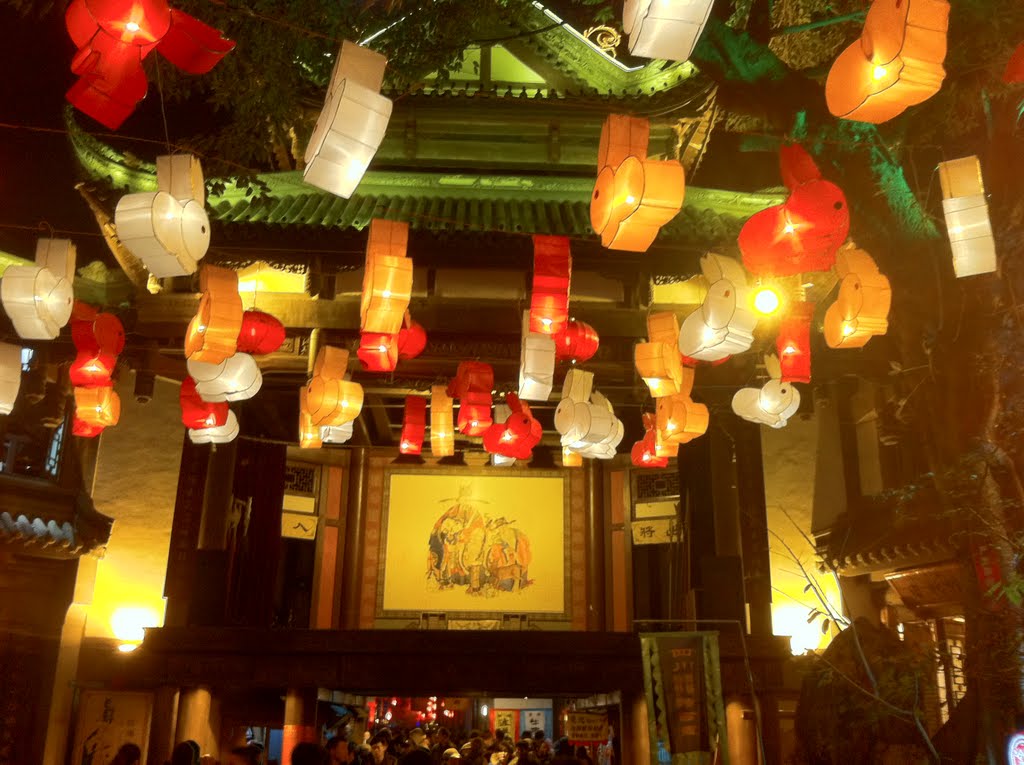
Aside from the fabulous food, Chinese New Year is a time for incredible decorations, all in the motif of the New Year, in 2011, bunnies. Rabbits were everywhere you looked. Department stores appeared to be merchandising our Easter. Rabbit lanterns were ubiquitous, colorful pastels in daytime and strikingly lit after dark.

Every year miniature (and not so miniature) orange and tangerine trees decorate hotel lobbies, businesses and homes everywhere. The orange orbs are reminiscent of gold coins, a symbol of wealth and prosperity.

And then there were the fireworks. I was mesmerized by the displays, all put on by individuals or families, which lit the Chengdu skies for hours on end as far as the eye could see (and in the park adjacent to the high-rise where I was staying).

Wishing everyone a Delicious and Prosperous Year of the Dragon!

新年快樂

myMEGusta Samples: Brasitas

Brasitas, of Stamford and Norwalk, CT, is named for ‘little coals’, so it is not surprising that the Latin Fusion menu in these sprightly decorated restaurants features a wide range of grilled goodies, as well as more complex offerings from the rest of the kitchen.

The menu reads somewhat simply, e.g. Pinchos de Churrasco (beef skewers), but this appetizer also features a crispy “yucca” (actually cassava, a Cuban staple) cake, creamy textured on the inside and crisp on the exterior. And this simple description does not give a clue to how perfectly marinated and grilled the tender chunks of skirt steak are.

Similarly, a selection of empanadas, a standard on Latino menus, arrive thoughtfully cut in half, perfect for sharing, their flavorful fillings enhanced by a creamy guajllo chile aji dipping sauce.

On a recent visit to Brasitas, we notched up our usual food sampling adventures with a mini wine tasting, focusing on three whites, all made of 100% Albarino grapes, from the verdant Rias Baixas region of northwestern Spain. Also called Green Galicia, the region is well known for Santiago de Compostela, a religious pilgrim’s destination since the Middle Ages and recently in the spotlight in Martin Sheen’s film, The Way.

We chose the Lusco, rich in the mouth and aromatic, to accompany the appetizers, and it complemented everything, from the ceviche to that excellent grilled beef.

Main courses range from the expected, a Latino paella (with seasonings more assertive than one would expect in a traditional Spanish version, and made with exceptionally moist rice), to shrimp quesadillas, accented with chili oil.

Portions are generous but not overwhelming and plated to facilitate sharing. Brasitas graciously avoids those annoying “extra plate” charges becoming common in too many restaurants, some of whose portions border on the ridiculous for one person.

A Latin Fusion standout was Pollo Criollo, perfectly moist roasted free range chicken breast with seasonings native to the Americas, bathed in foie gras infused Huancaina sauce. Originating from the Andes in Peru, this sauce is made of queso fresco (also known as farmer’s cheese), onions and yellow aji chiles.  Truffle oil mashed potatoes rounded out the plate.

Adega Condes de Albarei, clean and dry, on the light side but still fruity, was the group’s  wine choice to accompany the chicken, and to segue into Paella.

Next came Camarones al Ajillo, prawns with garlic.  But what prawns, jumbos and impeccably fresh, sizzling in a tomato garlic sauce! There was more: Baby spinach seasoned with toasted garlic, pungent enough to serve a punch, but at the same time mellow, and an attractively presented inverted cone of saffron rice.

Torre la Moreira, slightly crisper and with a prominent nose, was the perfect foil for these lively flavors, and made for pleasant sipping as we contemplated dessert.

Dessert offerings are limited, probably because most guests are so happily sated at this point, but myMEGusta diligently persisted, sampling two: Crepes in dulce de leche and a traditional Latino flan. This provided an adventure in tasting two types of caramel, the former the reduced sugar/evaporated milk so wildly popular in Latin America, particularly in Argentina, and the latter simply caramelized sugar which melts irresistably in the custard’s juices to be a light sauce. Both were excellent.

The reasonably priced wine list is limited, however the sangria is fabulous and Brasitas’ charge for corkage is modest.

Brasitas, 954 East Main Street, Stamford, CT 06902 (203) 323-3176

http://www.brasitas.com/

My Blue Agave Heaven

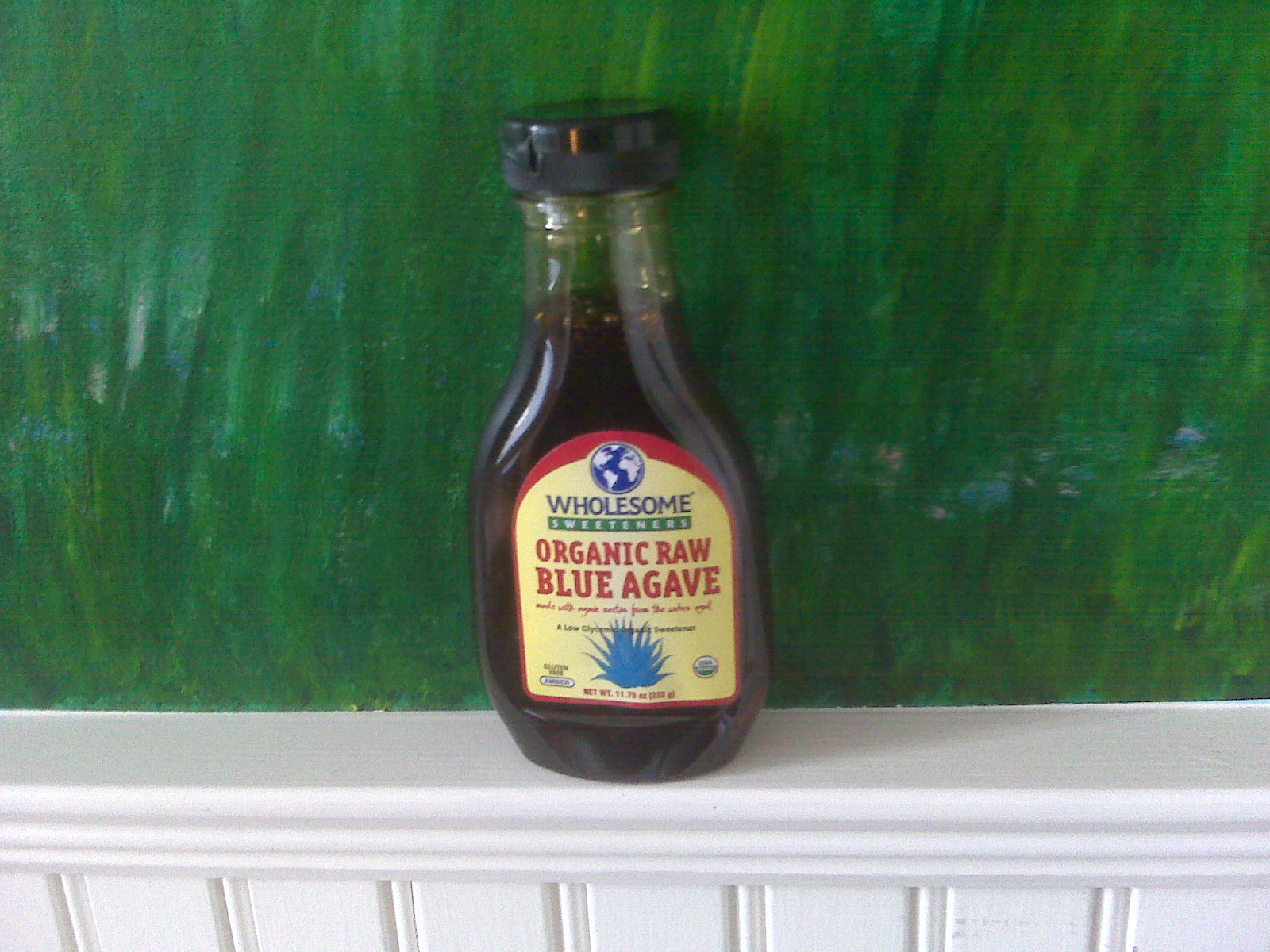
Blue Agave Syrup

It is splendidly ironic that the source of one of today’s most touted “healthy” foods is also the base for tequila, also delicious but not exactly an elixir of life.

Blue Agave in Mainau

My first encounter with an agave plant was among the dahlias and roses at the garden island Mainau,  in Lake Konstanz where Switzerland, Austria and Germany meet in the Alps (http://www.mainau.de/insel-impressions.html). Huge succulents with arms rising from a giant bulb, these formidable plants originated in Mexico. The most famous and widely cultivated commercially is the blue agave, from which the popular spirit is made (at least in part, more on that later).

The pina (the underground part which looks like a pineapple once trimmed) is the only part of the agave utilized.

Trimming the Harvested Pina 

It doesn’t have a lot of flavor before baking, the process which transforms the starches into sugars; the resulting mash is deliciously sweet and is then either made into the syrup (actually sweeter than sugar or honey) or fermented and distilled.

Freshly Baked Agave

All tequila is made from a minimum of 51% agave (often labeled “Made with Blue Agave”) grown in Jalisco, Mexico, with the remainder of the blend comprised of other sugars. But the best (and most expensive) are 100%, and always labeled “100% Blue Agave”.

As with any beverage alcohol, tequila should be enjoyed responsibly. One great way is the margarita. Now, myMEGusta is not talking about the watery things made from generic bar mix in too many establishments, she is referencing a real margarita.

Some prepared mixes are quite good, but the classic is the 3-2-1: three parts tequila, two parts freshly squeezed lime juice, one part triple sec.  It is possible to adjust the proportions to taste, particularly if this mélange is too tart (add more triple sec or lower the lime).  Salt on the rim is an option, as is the choice of rocks or straight up. Another variation is to substitute orange juice for part of the more acidic lime juice.

Or, try adding a bit of agave syrup, or substituting for some of the triple sec, for an added dimension which will also offset some of the lime zing. It will affect the color, but so does using golden hued tequila versus silver, and lends a mellow, smooth sweetness to the flavor.

Salud!

So You Think You Like Grated Wasabi on Your Sushi?

No, you probably don’t.

“Wasabi”, as we know it, is usually a reconstituted paste of dried, pulverized regular horseradish, ground mustard and/or mustard oil and some actual wasabi, plus other ingredients such as yellow and blue food colorings (to achieve the green hue).

This melange is what is so wildly popular, not only for sushi and sashimi but also for wasabi peas, wasabi grilled tuna and myriad other dishes.

It is possible to get freshly grated wasabi, but this is only found at the most elite (vis: expensive) restaurants and markets in Japan, and even more rarely in the United States. Most Americans have never tasted it and never will.

Wasabi root is very closely related to the regular horseradish we all know.  It is so expensive and rare, that clever chefs learned long ago how to make a reasonable substitute for every day enjoyment.

And here is where the fun starts.

A recent Stop and Shop visit yielded several examples of wasabi, which was a fascinating adventure in truth-in-labeling.  The reality may be that “wasabi” now means “tastes like wasabi”.

One item, powdered “wasabi” listed horseradish, turmeric (a yellow spice) and spirulina (a type of bluish green fresh water algae used as a dietary supplement) as the ingredients. At $3.99, it was not surprising that this contained no wasabi at all, but the product is probably just fine.

The most egregious example of misleading labeling read “Freshly Grated Wasabi” but  was made of: “Grated horseradish and wasabi roots, water, white distilled vinegar, soybean oil, mustard seeds, sugar, high fructose corn syrup, eggs, preservatives,  fd+c yellow #5 , fd+c blue #1” . Note that the horseradish and wasabi were listed together, so the latter is definitely a smaller proportion and potentially a tiny trace. “Freshly Grated Wasabi”, indeed.

Freshly Grated?

Other items on the shelf included a Tabasco-like wasabi sauce (colored with turmeric and natural chlorophyll), wasabi in a tube (no evidence of any actual wasabi in there, but probably quite OK), and wasabi peas (ditto and they are really tasty).

As Shakespeare-san might say: “What’s in a name? That which we call wasabi by any other name would zing as hot.”

Caving to Kraut Craving

First you hear the thunder of the engine roaring in the distance as it approaches.

Then silence, except for a few human voices.

“Breek breek breek” as it backs up. “Plop plop plop” as green orbs drop from the truck into their next lives which will be as choucroute, or sauerkraut, the wonderful pickled cabbage beloved to lovers of Alsace, German, Polish and virtually any other Northern European cuisine.

While there are certainly more modern production facilities for it, the artisanal factory visited a number of years ago near Strasbourg, France, was efficient while using centuries old albeit mechanized, practices.

First the farmer’s crop is weighed (and judged for quality), then the outer leaves stripped off before the cabbage heads are washed, shredded, then transferred to giant vats to cure. The owner looked askance at these pesky American tourists until he realized that a) we were fascinated, b) asked good questions and c) genuinely loved his region and its wonderful cuisine, especially the famous “choucroute garni”.

My earliest memory of sauerkraut is that it was vile: sourness in a can, salty and acidic without much else going on. This may be adequate for garnishing a Reuben sandwich with lots of other flavors, but by itself, not appealing unless it’s some kind of comfort food that Oma (your German grandmother) used to make.

Then I discovered “choucroute garni” in Paris and became a convert for life.  The kraut trick is that the pickled cabbage needs to be thoroughly rinsed to bring the acidity down, then cooked with other ingredients which, depending on the nationality of the dish you’re making, can include onions, garlic, chicken stock, beer, white wine, smoked pork or bacon, carrots, caraway, juniper berries, duck fat, a wide range of seasonings. And sausages and other goodies can simmer in it, adding additional flavor notes.

On a recent sojourn to Munich and Vienna, every serving of sauerkraut that appeared on my plate was different, some more acidic, some with the taste of browned onions in the background. They were all good, every single one.

A new stateside favorite for me is Polish sauerkraut soup, tasty and complex.

The best way to buy sauerkraut is fresh, from a barrel.

Fresh Sauerkraut at the Vienna Naschmarkt

Often the farmers’ market pickle vendor has a stash of irresistible fresh kraut. Unless entertaining a crowd, I’ll cook up a pot then add one or two garnishes per meal, perhaps a piece of kielbasa or other sausage, perhaps a smoked pork chop.

Freezing the leftovers is suboptimal, but considerably more efficient than getting back on the plane to Munich.

Of Myths and Gingerbread Men

It’s easy to confuse gingerbread with “Christmas”.

After all, you have gingerbread men popping up in car commercials (exhorting us to lease a rather forgettable automobile brand) and architecturally in gorgeous gingerbread houses with candy cane joists.

But like most of what we associate with Christmas, gingerbread has absolutely no religious significance, a characteristic it shares with holly, decorated fir trees and wreaths. These are all accoutrements invented by creative Northern Europeans to brighten dark winter days, and especially to make the holiday as beautiful and festive as possible.

The dried, ground version is the main seasoning for gingerbread of all types, the cookie like shapes we love (both at the holidays and as ginger snaps) as well as the softer cake which is so aromatic, also known as “pain d’epices” in France.

Beyond its use in baking, ginger is one of the world’s most versatile seasonings.  Sliced, fresh ginger is a foundation for Indian and Chinese cuisines, which also utilize it dried. Pickled ginger is a must to accompany Japanese sushi. Its soft pink blush is a byproduct of the pickling process, not food coloring (although the darker variety you sometimes see has been made with red plum vinegar).

The sautéed spinach with fresh ginger at the Blue Lemon in Westport was a revelation on one recent evening. It was even voted one of the state’s best side dishes in Connecticut Magazine’s Best of Connecticut 2010.

Then there are ginger tea, ginger ale and stronger tasting ginger beer, not spicy at all, and supposedly yielding some health benefits. Not having any medicinal properties, but quite delicious, is the Dark and Stormy, a concoction of ginger beer, dark rum and a squeeze of lime.

Too dubious to purchase and sample, was the White Ginger Cosmo I spotted on a drink menu: “freshly muddled ginger shaken with Absolut Citron Vodka, Mandarin Napoleon and white cranberry juice.” If any readers have tried this, leave a comment!

Wishing everyone a Spicy Holiday Season!

Bullseye! Homing in on Where to Dine Out

Think about it: Selecting a restaurant in a new city, or even a new neighborhood, can be daunting.  All you can go by is looks, the shallowest of measures, a little like a college mixer.

But sometimes, there are little cues and clues that will raise your likelihood of having a delightful dining experience. Or, if you are paying attention, these signals will save your evening by sending you elsewhere, fast.

Rule #1: Trust your instincts

I am remembering my first experience with Paul Prudhomme’s legendary Cajun cuisine. It was in the early ‘80s, and I was wandering around the French Quarter as lunchtime approached. Something about the appearance of K-Paul’s Louisiana Kitchen, a hole in the wall, caught my eye. The menu was enticing, the smells were spicy siren calls and the place was sparkling clean. Of course, this little love-at-first-sight lunch joint turned out to be the jumping off point for the whole Prudhomme empire.

Rule #2: Look for Real Food Cooked by Real People

Many years later, on an early Rome morning, I wandered the streets of the Trastevere neighborhood, where Romans actually live and work, but which is also convenient to attractions like the Coliseum. I looked up from my jetlagged reveries to see a man carrying a calf carcass into a homey looking restaurant, La Tana de Noantri. I made a point of returning later for dinner. Sure enough, there were a number of veal daily specials including brailed veal tail, one of the most succulent cuts of any animal when properly cooked, in this case with celery, and served with garlicky escarole.  Oh Heaven! Oh Cielo!

Rule #3: Eat Local

Americans are famous for complaining that the food in (fill in the blank) is no good, when all they order is typical American fare like burgers. We do make the best burgers in the world, and ordering them anywhere else is a minefield. I remember Brit colleagues who always enjoyed pub burgers when in the United States, because they were so lousy at home. Chinese food is another issue: Do you really want the Bavarian interpretation of Peking duck when you could be having a world class sausage? Or a hot dog in Hong Kong instead of dim sum?

Rule #4: If It Doesn’t Feel/Look/Smell Right, Leave

If you’re abused by the host for any reason, just wait until you sit down and the haughty wait staff gets their chance. Restaurants known for treating unknowns like second class citizens have earned that reputation, and don’t deserve your business. Once seated, look closely at the menu, the most important marketing tool the restaurant has. If it’s filthy, it’s conveying a message (“Get out now”).

Wishing you dining adventures that only need Rules #1 through #3!

Flaky Times in a Flaky World

Quick: What looks like an oyster, but is crunchy and a little sweet?

And is related (in spirit) to custards in Macau (or any pie, for that matter) and baklava and strudel?

We’re talking sfogliatelle (say it with an Italian lilt: svohl-yah-TELL-eh), the crinkly, ricotta filled pastries from Naples which are, in my opinion, the crowning glory of Italian pastry.

What makes them so charming, in addition to being absolutely delicious, is that they look impossible to make, almost mysterious.

Sfogliatelle!

And what makes them part of a glorious international constellation of flakiness is the simple combination of flour and water and fat, folded or rolled to create countless layers.

Anywhere you go in the world, you will find a variation on this theme.

Travel to Ohio, and there’s good old American pie, best with a crust made of lard, sadly compromised with the invention of Crisco. The French call their pie crust Pate Brisee, and use butter. These are simply moistened flour tossed in butter then rolled. (Yes, DO try this at home.) The best custard tarts I have ever had were still hot from the oven in Macau (near Hong Kong), descendents of Portuguese cooks’ creations centuries ago.

Custard Tarts in Macau

On another level are the stretched doughs into which layers of fat, usually butter, are folded or rolled.

The French make their mille-feuille (thousand layer) through a rigorous process of rolling, smearing with butter, then folding, rolling, resting, folding, rolling, resting. “Napoleons”, by the way have nothing to do with the little emperor, rather the word is a bastardization of napolitan, referring to Naples, Italy.

Then there are the pastries which start with the creation of one vast sheet of dough – flour and a liquid – and a filling.

Strudel, baklava and sfogliatelle all have this in common. Everyone loves leafy phyllo, layers of crispness, honey, and nuts. Strudel starts the same way, and you can see yours being made at The Great Market Hall, the huge indoor market in Budapest, Hungary.

Making Strudel at The Great Market Hall, Budapest


But sfogliatelle are the sexiest of all, and even TV stars.

“The Sopranos” producers were inundated with recipe requests every time the characters enjoyed them, even though real life Italian homemakers rarely make them (too time consuming and too easy to find at the neighborhood baker). Michele Scicolone (www.MicheleScicolone.com), co-author of The Sopranos Family Cookbook, answered this demand by creating a relatively easy, user friendly recipe.

Connecticut denizens have easy access to world class sfogliatelle at DiMare Bakery (Stamford and Riverside, www.dimarepastry.com ). Their minis (on the weekends) make this flaky indulgence even more irresistible.


Post Navigation