myMEGusta

Named for things that please me (“me gusta” in Spanish) and rhymes with balabusta (Yiddish for “good homemaker”).

What is the Difference Between Hot Gazpacho and Tomato Soup?

Answer:  About $10

Gazpacho

It’s easy to abuse gazpacho.  After all, it’s just pureed raw vegetables, their quality making the difference between being delicious and being just glorified V8 juice. Made with sun ripened, local tomatoes at their peak of flavor in the summer, it is a super simple treat.

Like many beloved food names, the word gazpacho has come to mean something other than its original connotation. Today it can be any pureed vegetable concoction, usually served cold, but sometimes not.

The word’s origin is lost in history with various scholars attributing it to Arabic, Greek, Hebrew or Latin.

There are white gazpachos and green, but the classic has a tomato base, sometimes embellished with a little vinegar or olive oil. Easily made in these days of blenders and food processors, it’s a cold mélange of tomatoes (maybe seeded and/or peeled), maybe peppers, garlic, onion, stale bread, olive oil, vinegar or lemon juice (depending on how flavorful your tomatoes are). To be really authentic, and have a coarser texture, pull out the mortar and pestle.
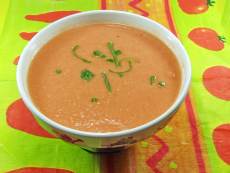
Gazpacho

Believed to have originated in Spain, gazpacho recipes vary by where it is made and the tastes of the person making it.  The Andalucía and Catalonia regions (and maybe others) claim to be its birthplace, but it surely originated earlier, perhaps in the Middle East or ancient Rome. Whatever your favorite Mexican haunt wants you to believe, it is definitely not of Latin American heritage, other than by way of the conquistadors.

Regardless of where it was invented, I was delighted with the version presented at an “authentic Slow Food” Catalan restaurant in Barcelona on a hot summer’s day: Watermelon Tomato Gazpacho. Bright red and extremely light with no bread or other thickening, it was poured over a tiny garnish of red watermelon and tomato cubes resting in a pool of Spanish olive oil, which rose to the shimmering surface making little dots. I later learned that a friend from Madrid (who is an excellent cook) routinely puts melon into her gazpacho blend.

Gazpacho at the Supermercado

You can occasionally find pre-made gazpacho in US supermarkets, but in Spain, there are whole sections devoted to it.

White gazpacho is made from pale ingredients like cucumber, garlic, almonds, lemon, maybe a little parsley or cilantro or white grapes, and is often served with a seafood garnish.
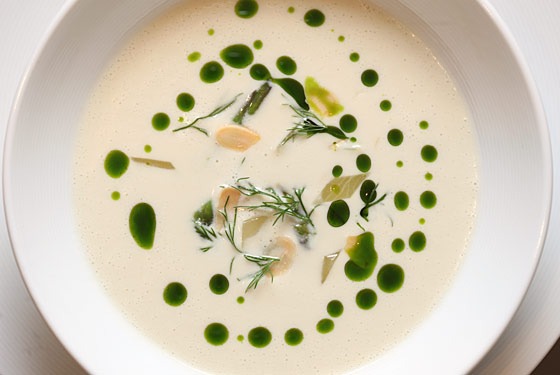
White Gazpacho with Olive Oil

The green version is a puree of raw green vegetables with a little vegetable or chicken stock, or a little cream.
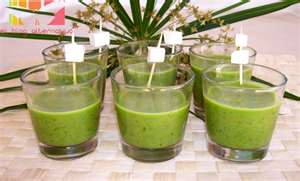
Green Gazpacho

On a totally inauthentic, but probably delicious, side are things like mango gazpacho, to which I say, why not call it cold mango soup?


Artie the Artichoke

How did a vegetable go from being a favorite food in ancient Rome to being the mascot of a college in Scottsdale, Arizona?

It’s a long and circuitous tale, but the simple answer goes back to the early 1970s (Boomers: Remember those days of college protests?).  The student body became aggrieved at the administration’s refusal yield to their demands in several budgetary areas. In protest, when they were fully empowered to pick a mascot, chose a funny looking vegetable. Go to http://www.gochokes.com/ if you don’t believe this.

Never having tasted an artichoke until I arrived in France many years ago, I was immediately smitten, particularly when I realized how easy they are to prepare (if you have the right shears and a good steamer), and how much fun to eat.

Artichokes Growing in Vietnam

Artichokes are native to the Mediterranean, and most of the world’s crop is still grown in Europe. Italy leads in production, but they are cultivated in warm climates all over the planet, including in the mountains of Vietnam where I was surprised to see them. The vast majority of artichokes consumed in the United States come from Castroville (“The Artichoke Center of the World”, if you ignore the rest of the world) in coastal Monterey County, California.

Terrace Farming, Dalat Vietnam

The plant itself is a thistle, a relative to the pesky weeds that have pretty purple flowers but painful protective needles.

Artichokes can be simply trimmed and steamed, then eaten one leaf at a time, dipping in vinaigrette or mayonnaise, taking a break to trim out the fuzzy ‘choke’ in the center then eating the heart. Or, the cooked artichoke’s fuzz can be eliminated in the kitchen, and the whole thing stuffed with seasoned breadcrumbs, then baked (a little more decadent).

Baby artichokes do not require as much trimming. One personal favorite dish in Roman cuisine is “carciofa alla guida”, baby artichokes in the Jewish style, a specialty of the Trastevere neighborhood. These are simply baby artichokes fried in olive oil. Just delicious, and they can also be found at Fiorello’s in New York City.

Jarred, marinated baby artichokes are always there for the lazier artichoke lover who wants nice addition to antipasto.

As for Jerusalem artichokes, also known as sunchokes, this vegetable tastes vaguely of artichoke, but it is not even remotely related.

Jerusalem Artichokes, aka Sunchokes

Native to North America, this is a type of sunflower which produces tubers at its roots, and can turn into an invasive weed, so home gardeners, beware!

Breaking the Code on the “Soft Shell” Oxymoron

Soft shell lobsters? Soft shell clams?  Soft shell crabs?

The subject is totally confusing, and the term, “soft shell”, has a totally different meaning in each tasty case, all of which are currently in season.

As readers may recall from a blog on crabs last fall (Everyone Deserves Their Crabby Moment, November 21, 2011), soft shell crabs have slipped out of their hard, protective shells in order to grow larger, at which point the shell re-calcifies to rock hardness. It is possible to find these treats in the wild, but difficult, since the animal, very vulnerable to predators, hides away in a sheltered spot, trying to keep invisible until the shell has re-formed.

Deep Fried Soft Shell Crab

Today, commercial crabbers take some of the crabs from their regular catch and keep them alive and healthy while awaiting the magic moment in the dark new moon (no moon, in other words) when they will naturally shed, have nowhere to hide, and then be carefully packed to go to market. The shell should be paper thin, and the little beast is completely edible (less the gills and the eyes/head clipped off when cleaning).

Those of us who live on the East Coast can find the crabs still alive in good fish markets; even the best shops in the rest of the country rarely have them still kicking.  Like any seafood, soft shell crabs are at their peak of flavor if only seconds elapse between being cleaned (a euphemism for killed) seconds before hitting the pan. The blue crab is top of mind for this dish in the United States, but other varieties are used in other places, such as Japan and Venice, Italy.

My first experience with these wonderful treats was many years ago in Baltimore in the heart of blue crab country. We visited a huge market on the waterfront, and my hosts were raving about these things, which sounded totally bizarre to my naïve ears, and looked even worse: sizzling deep fried sea monsters slapped between two slices of wonder bread.  Always the intrepid eater, I took a bite and was in heaven. The sweet delicious flavor of the crab burst out of the super crispy, yet chewable shell, hot and a little messy. I probably had a second one.

Steamed Lobsters All Look Alike, Soft or Hard Shelled

So, do lobsters molt, too? Yes! And have clever lobstermen created the same system for their related crustacean catch?

Nope.  Soft shell lobsters should probably be called “sorta soft shell” because these shells are most definitely not edible. But they are lightweight and easy to crack open, their meat being extra sweet, and considered a real delicacy. Because of their fragile shells, they don’t ship as well, and so have traditionally been most common in shops and restaurants areas close to the sea, although this is changing with modern shipping techniques and consumer demand elsewhere.

And soft shell clams are another story entirely. They are a totally different species from the hard shell clam types (also known as quahogs, littlenecks, cherrystones, as well as manila clams, razor clams and giant clams which are all different).

Soft Shell Clam on the Right

The soft shell clam is also known as a steamer, and is known for its succulent belly, wonderful steamed, dipped in butter, or deep fried. A real staple in New England, these are the clams traditionally used in clam bakes, although some chefs and consumers are substituting hard shell clams (usually littlenecks) for this purpose.

The delicious quahog family is a story for another day.

Yogurt: Health Food or A Big, Expensive Lie?

It can be either, and the smart eater makes the right choices.

What exactly IS yogurt? An expensive way to drink milk? No, not necessarily. Yogurt, like cheese, is one of the world’s oldest processed foods. Plain yogurt is simply milk which has been heated to kill the microbes, blended with selected bacteria and allowed to ferment.  Yes, it’s more expensive than drinking a glass of milk, but also a lot more interesting. And, for some people, it is easier to digest than milk, as the culture breaks down lactose which can mitigate lactose intolerance.

Frozen Yogurt

What about frozen yogurt? If you’re eating it because it is delicious, that’s fine. But, don’t indulge because you think it’s a health food. Frozen yogurts can be packed with as many calories as ice cream, or contain artificial colors and sweeteners which you may or may not want.

What makes it “Greek”? This yogurt is strained to eliminate some of the whey (liquid) so it is thicker and more concentrated than regular yogurt because it has a higher percentage of milk solids.

Fage lays claim to inventing Greek yogurt in a small shop in Athens in 1926, later growing a significant business in Greece and initiating imports to the United States in 1998. They were one of the first to start manufacturing in Upstate New York, whose dairies are new booming thanks to this craze.

How about those new “Probiotic” yogurts? Activia, for example, contains live cultures known as probiotics. There are health claims that these bacteria help in digestion and these products have a significant following, particularly among people with digestive disorders. Some additional yogurt brands (e.g. Chobani and Oikos) contain probiotics but don’t actively promote it; others do not (e.g. Fage).

Yogurt is incredibly versatile, and there are innumerable dishes around the world made with it. Interestingly, many internet recipes for centuries old dishes now specify using Greek yogurt, a testament to the how wildly popular this relatively new concept has become.

Tzatziki in a Meatball Sandwich on Pita Bread

Some of myMEGusta’s favorite yogurt concoctions are:

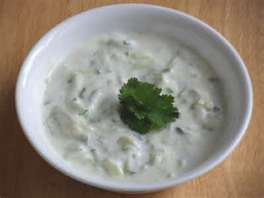
Tzatziki – A traditional Greek sauce sauce made with grated cucumber, lemon, dill, used as a dip and in pita sandwiches such as gyros or souvlaki

Cucumber Raita

Raita –A similar Indian dish which is wonderful accompanying hot foods: yogurt with cucumber, with seasonings such as mint, cumin, paprika or cayenne

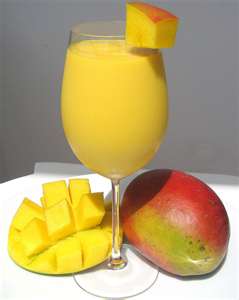
Lassi – Another treat from India: yogurt blended with fruit, e.g. mango,  with no need for sweetener if the fruit is ripe enough

Mango Lassi

“Fake” crème fraiche – Beat Greek yogurt until smooth and add a sweetener (try agave syrup!) to make a tangy fat-free dessert sauce, e.g. for berries, maybe adding cocoa or other flavorings

Quick Quiz: Who’s Frank Meyer?

Quick answer: Hardly anyone cares, and even he didn’t know he would be famous in the world of gastronomy.

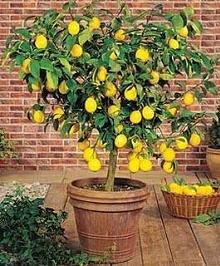
Meyer Lemon Tree

In the early 20thCentury, the USDA employed “plant explorers” whose mission was to travel the world in search of exotics which would then be introduced to the United States.  Of course, this is the opposite of what we do now in assiduously avoiding the introduction of potentially dangerous new species (or new diseases along for the ride) here.

Frank Meyer was one of these men, assigned to China. One of the items he brought back  was an unusual lemon tree, easy to grow and beautiful, but whose fruit was too thin skinned to be commercially viable, so it was considered an “ornamental”. It was not well known outside the world of botanists, horticulturalists and landscape designers for over half a century, although it did bear his name.

Enter Martha Stewart.

Organic Meyer Lemons

Always on the lookout for something unique, she started using Meyer lemons in her recipes, and the species became wildly popular.  A cross between a mandarin orange and ‘regular’ lemon, Meyer lemons have a sweeter and less acidic flavor, and can even be used thinly sliced with the rind on as one might  an orange. They can be used in lieu of either of these, or of limes, in many recipes.

Meyer Lemon Cupcake

The season mirrors that of other citrus, the winter months. Fresh Meyer lemons are rarely seen commercially other than in farmers markets in the warm climes where they are grown or specialty stores like Whole Foods. Like other citrus, they are, however, available in additional months to the trade, which is why dishes made with them can appear on menus out of season.

It is also possible to purchase Meyer Lemon Concentrate, a frozen product which is certainly finding its way into (and probably the dominant source of Meyer lemon) in restaurants, especially when the fresh product is not available. MyMEGusta has not done a side-by-side tasting of dishes prepared from fresh and from concentrate, and welcomes comments from readers who have. Perhaps this will be a project for next winter!

Pease Porridge Hot…

How many generations of parents and little kids have quoted this and not had the vaguest idea as to what the idea of “pease porridge” was and why people ate it?

There was a time when sugar snap peas did not exist, snow peas (“mange tout” or “eat it all” in French) were considered quite exotic, and the only way most people ate regular peas, also known as English peas, was the dried version. Split pea soup (especially delicious when made with a ham bone or hock) was wildly popular, and a staple food year round. “Pease porridge in the pot, nine days old” was a reality, as the pot might have been reheated over and over (not recommended, by the way).

Fresh peas were not taken for granted, and the short season was celebrated, a tradition which I carry on, seeking out this treat at the farmers markets, although the best of the best is when you can go to a U Pick It farm and select your own pods to rush them home and enjoy immediately at their peak.

Peas on the Vine

Peas are one of the few foods which are often better frozen than fresh, the former picked at that peak and processed immediately while the latter may have been picked overripe then languished in shipping or in storage for days, with what remained of the delicious sugars rapidly turning to starch. You can make fabulous puree of “fresh” pea soup with the frozen ones and no one will know the difference.

For shoppers, it’s easy to succumb to the false economy of seeking out the fullest pods only to be disappointed in the flavor. Look for shiny green pods, not dried out and not too full, and the little green orbs inside will be at their sugary peak.

Sugar snap peas (edible round pods) and snow peas (edible flat pods) are delicious, too. Like regular peas, they should only be barely cooked, just enough to heat them through. I like to simply blanch them, then season with butter or sesame oil or toss into another dish to finish, perhaps a pot of risotto or new potatoes.

Pea Shoots

Pea shoots, the tendrils and baby flowers, are a personal favorite and taste like a cross between spinach and peas. The best way to obtain them is to grow snow peas and just snip before the pods start to develop; alternatively, they are usually available at Asian markets. Look for them in Chinese restaurants, called “dau mui” (dow-my), often stir fried with oyster sauce or garlic.

Another Asian approach to enjoying this little vegetable is in delicious wasabi peas.

Cow peas, also known as black eyed peas, are distant relatives of green peas, not at all like them, and we’ll take a closer look at them on another day.

Café Culture?

Close your eyes and imagine you are sitting in a café.

Perhaps on the Champs d’Elysees, watching the Parisians and tourists stroll by as you sip a pricey mineral water or orange presse (fresh squeezed orange juice). Maybe at Café Florian in Piazza St. Marco in Venice, with music wafting in the background, pigeons overhead (wear a hat) and Prosecco in hand.

If you hop into the Wayback Machine (for those of you old enough to remember The Rocky & Bullwinkle Show) and seek out the oldest of the cafes, the ancestors of them all, you will find yourself transported to 17thCentury Austria, sitting indoors in Vienna, where the concept was born.

During the Ottoman wars, the city had been occupied by the Turks. On being liberated by the Polish-Hapsburg Army, Vienna was quickly emptied of the invaders who left things behind, as people on the run tend to do. Among the remainders were bags upon bags of coffee, and the accoutrements it took to brew it.

Vienna Coffee House

What had been an exotic luxury became available to the masses in the newly invented coffee houses, outlets created specifically to prepare and serve this beverage which was new to most people.  Some traditions which live on today were established in those early years: myriad varieties of coffee preparations to choose among, and the freedom to sit for hours on end, reading, talking, just staring into space.

Cafe Schwartzenberg Vienna

Starbucks lovers take note: Some things never change.

On a recent trip to Vienna, I visited several coffee houses, mostly for a quick coffee or aperitif, but on one occasion for lunch at the venerable Café Landtmann, a fixture on the Ringstrasse since 1873, now a serious restaurant in addition to being a coffee house. From my notes: “venison ragout with allegedly local cranberries, potato croquettes, porcinis and other fresh wild mushrooms.” It was delicious and satisfying, so I passed on the gorgeous pastry display.

The most interesting part of this was the coffee menu, too elaborate to paraphrase here:

http://www.landtmann.at/fileadmin/content/pdf-dateien/Kaffeeposter_Landtmann.pdf

The Viennese coffee house continues to evolve.  I remember my first visit to this beautiful city, many years ago, before tastes and health concerns changed the laws about indoor smoking.  Even in some of the finest and most historical examples, coffee house walls were a little dank, and smoke permeated the air. When I visited in late 2011, I did not encounter any problem whatsoever with smoke in any coffee house or restaurant, although this could be a result of my seeking out non-smoking areas (which did not exist in the past) and ignoring smokers’ siberias. Bottom line: it is no longer a problem.

Franziskaner: Coffee with steamed milk and whipped cream

I need to go back, and research a blog on “mit schlag”, German for  “with whipped cream,” and not ignore the Sacher Torte next time.

It Didn’t Happen in Rio

But it did in Paris.

The exact location was the Discophage, a Brazilian hole-in-the-wall restaurant/caberet in the Latin Quarter, near the Sorbonne. The wife was in back (cooking), with the husband, Carlos, in the front (hitting on customers), and musicians playing sambas (when they weren’t also hitting on customers). Some young French and American women fell in love with the guitarists; I fell for the feijoada.

Feijoada

At its simplest, it’s a black bean stew with chunks of porky things and tongue, served with manioc flour (a tuber also known variously as cassava, tapioca, or yucca), orange slices, kale and a vinegar sauce, accompanied by rice. Normally, a pot of beans and meats arrives at the table with the bowl of rice, surrounded by a bevy of other small dishes containing the various garnishes.

Pronounced “Fey-ZWAH-dah”, its name derives from the Portuguese for “black bean”, and originated in that European nation, although now is more associated with their former colony, Brazil.

I’ve sought it out in New York, and, over the years, have found very credible versions at Brazilian restaurants that come and go, although you won’t find it at the otherwise wonderful churrascarias (Brazilian barbecues) popping up all over.

Business meals in Sao Paolo and Rio de Janiero never afforded the opportunity to try feijoada at the source. Just like in the United States, the locals take visiting firemen to “the local Chamber of Commerce restaurant,” as Calvin Trillin would say, instead of where the locals eat the really good food.

But I hit the mother lode during a side trip to Iguazu Falls, where Brazil, Argentina, and Paraguay meet.

Iguazu Falls

This occurred many years ago, so the hotel, not yet trained to focus on burgers, spaghetti and sushi for tourists, instead served a feijoada buffet for lunch.

At least ten pots bubbled with assorted sausages, pork chunks (including belly, another day’s blog), and odd parts, including perfectly braised tongue, all cooked with black beans. Mounds of manioc and rice and orange stood by, with a few different vinegar sauces and freshly cooked kale.

It is a rich, peasanty food, and carries a high risk of overindulgence, particularly as the plate gets loaded with all the components. So, have plenty of kale and oranges, skip the dessert, and Bom Apetite!

Three Buckets of Tea

No, this is not a saga about getting lost and found in Afghanistan.

It is how I see “tea” falling into three buckets: raw tea (green tea being the best known and most popular), processed tea (black tea and oolong, for example), and all sorts of other infusions which have nothing to do with what grows on tea bushes (and which we’re not going to talk about today).

Tea Leaves

All real tea comes from the same type of plant.  What makes the tea in your cup different depends on the quality of the tea leaf when harvested (the smaller the better and more expensive), how it was processed, whether not processed at all, or wilted, fermented partially or fully, how dried (heat or smoke), whether rolled or crushed, and, of course, how it was brewed.

Portuguese Ship, circa 1600

Portuguese traders were the first to carry tea throughout the world, and it is they who introduced it to England, who took such a liking to it (as well as silk and porcelain) as to create a massive trade imbalance with China. To address this, the Brits started selling huge quantities of opium to the Chinese. The societal problem that caused, plus their general dislike of foreign traders, led to the Opium Wars.

Most tea names have to do with production processes (black tea, oolong). Sometimes they are named for where they were grown (Assam and Darjeeling, both regions of India), or for their appearance (shotgun, tea leaves rolled into tiny balls and dried), or for flavorings. Some are blended to a corporate style, such as Twinings versus Bigelow having different flavor profiles in their identically named English Breakfast teas, or Lipton versus Tetley.

Bergamot

Among the flavor enhanced teas, Earl Grey is one of the best known (flavored with oil of bergamot, a type of bitter orange), related to Lady Grey (like the Earl, but with lemon and additional kinds of orange rind). Smokey flavored Lapsang Souchang is a personal favorite. Constant Comment is an example of a spiced tea, with notes of orange peel.

Moving from the sublime to the ridiculous is a product called “Monkey Picked Oolong”, which might actually be wonderful but reminds me of the stale jokes about a wine snob sniffing a glass and opining that it was “picked by a blonde fraulein named Brunhilda in the early afternoon.”

The innumerable types of Chinese and Japanese teas are traditionally consumed with neither milk nor sugar nor lemon, although Indian teas tend to use dairy and a sweetener, probably resulting from English habits adopted during the Raj. Chai tea, often served as a cold latte, is a descendent of this, seasoned with Indian masala blend spices.

Green Tea Ice Cream

Two of my favorite tea concoctions are green tea ice cream and its relative, Starbucks Green Tea Frappuccino, effectively a green tea ice cream milk shake. No, consuming green tea this way is not a healthy choice.

The Japanese Tea Ceremony is well known but little understood, more about an elaborate traditional ritual and showing respect to one’s guests, than anything special about the tea itself, whisked from a fine powder and quite bitter.

Japanese Tea Ceremony

There is a perpetual debate regarding teabags versus loose tea, the latter supposedly being better because “they hide the bad tea in the bags”. For commercial brands, this is really a matter of the packer’s quality control. The newest container is the H-Bag, made by Bigelow for Keurig machines.

Very serious tea shops are sprouting up, offering wide selections of the best available teas brewed the exact number of seconds to be perfect, “cuppings” (a fancy word for “tastings”), and tea friendly menus. Two excellent examples are The Steeping Room in Austin, TX (www.thesteepingroom.com) and Savvy Tea Gourmet in Madison, CT (www.savvyteagourmet.com).

A Toast to Wedding Cakes

They can be the perfect culinary marriage of exquisite beauty and luscious flavor.

Or not, since some don’t deserve to be celebrated. Sometimes the prettiest on the outside can be the ones with hearts of stone, or at least they taste that way.

But the one I’ll be enjoying at the wedding of two friends this weekend will be elegant and delicious, which I know because I’ve had cakes from this Chinatown bakery before. Remember the old adage: “You cannot save your cake and eat it too”? This references the superstition that if a woman puts her slice of wedding cake under her pillow, she will dream of her future husband. I’ll be eating the cake.

“Liberated” Wedding Cake

Like many other things that were liberated in the sixties, wedding cakes have undergone a wonderful transformation from the staid norm of white cake/white frosting, to anything goes, like chocolate, red velvet, tres leches (Mexican “three milks” cake), carrot cake or even cupcakes artfully arranged in tiers.

Cupcakes!

Bakers sometimes decorate with real or marzipan flowers, not just squiggles of white fondant which used to be the norm, or royal icing, a hard, sugary frosting so named because it was used at Queen Victoria’s wedding cake. As a side note, her wearing of a white gown started another bridal tradition that lives on today.

Traditional Decoration

Feasts have always been part of celebrations like weddings, so it’s not surprising that cake would be part of the ritual. For example, it is documented that in medieval England the bride and groom would kiss over a pile of pastries, and would have good luck if they didn’t knock it over.

Croquembouche

In France, the traditional wedding cake is a croquembouche, a stacking of cream filled profiteroles bound together with light caramel.

I have never really understood the whole concept of groom’s cake, very popular particularly in the South, and sometimes in masculine, humorous forms representing his hobbies or interests. It is usually darker in color, often fruitcake, and is often wrapped to snack on the next day. Or to use as a paperweight, depending on your opinion of stale fruitcake.

Groom’s Cake for a Football Fan

Post Navigation